I'm researching where Taiwan's
L3 radar sits on the world map.
I'm a MIMO radar engineer, and for seven weeks I'm in Silicon Valley to research one question — not to sell anything: how does a Taiwan radar subsystem become the standard module a global platform like Anduril or Shield AI can't ship without? Mostly, I'm here to learn.
The one question I'm chasing for seven weeks
How does a Taiwanese L3 radar company go from an independent player to a Tier-1 standard-module supplier that global system houses like Anduril or Shield AI can't build without — what gates lie on that path, and where might it fail?
If even 1–2 Taiwan radar firms reach Silicon Valley Tier-1 status, the pull on Taiwan's GDP could rival what semiconductors did in the 1990s. These are high-value-add subsystems (30–50% margin) — less a defense question than an economic one.
In the last 12 months Anduril and Shield AI expanded into Taiwan, and DIU moved to post a liaison to AIT. The supplier window is opening — and once it sets, it may not reopen for 5–10 years.
The system houses' real procurement logic and integration thresholds — Lattice API specs, timelines, pricing — aren't public; they can only be learned face-to-face. That's the whole reason I'm going, instead of writing this from a Taipei desk.
I've turned this into four falsifiable hypotheses — but what I need now are the people who actually live in this world: a radar engineer, an OEM buyer, an investor, someone who's walked SBIR/OTA. If that's you, I'd genuinely love to talk.
Where I think Taiwan sits — tell me where I'm wrong
Before going, I built a working model: the radar value chain in five layers. Taiwan owns L1–L2 at world-class level; the real opening looks like one cross-layer move, from L3 up to L4. Click a layer.
I'm the engineer, not a consultant
I don't just research this industry — I build inside it. On a ZCU111 I work hands-on across the whole thing: the hardware and RF circuitry, the end-to-end system chain, the host-side control front-end, and the tracking algorithms I'm researching. The simulation below is a live version of that signal chain — move the controls and everything recomputes.
New to radar? In plain terms: the glowing wedge is where the antenna is "looking." Steer it across a target and watch the echo pop out of the noise (the range–Doppler map) and get tracked on the scope.
Try it: the scene already has an aircraft (A), a drone (D) and a bird (B) — steer the beam onto the tiny bird, watch it vanish into the noise, then add TX/RX elements, turn on pulse compression or raise SNR to pull it back out (hover any control's info icon to see what it does).
A bit about me
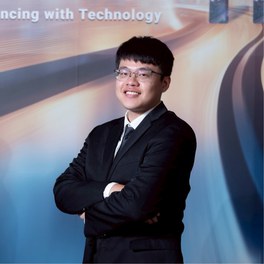
I'm Robert Chang, a master's student at NTU's Graduate Institute of Communication Engineering, where I design and validate information-fusion algorithms for MIMO radar. I came up through NTHU's EECS program on terahertz imaging and signal processing, so I'm comfortable moving between the RF bench, the FPGA, and the host-side algorithm.
What I enjoy most is being the person who has actually touched every layer of a system, then going to find its real ceiling. Outside the lab I've done cross-border work bridging technology and business in Epoch Foundation's MIT group and co-founded a non-profit repair community. Happy to talk radar, dual-use hardware, or anything that connects Taiwan and Silicon Valley.
- Based inBased in Hsinchu and Taipei, Taiwan; in the Bay Area Jul–Aug 2026
- EducationM.S. Communication Eng., NTU (2025–27) · B.S. EECS, NTHU (2021–25)
- Focus nowMIMO radar baseband on a ZCU111 RFSoC — DBF, pulse compression, CFAR, tracking
- LanguagesMandarin (native) · English (professional)
- CertificationsAzure AI Fundamentals (Microsoft) · Transformer-Based NLP (NVIDIA DLI) · Altium PCB Design
Built & been part of
Honors & highlights
If you're one of these, let's grab a coffee
I'll be in the Bay Area this summer (Jul 6 – Aug 21) and I'd love to meet — coffee's on me. Not in the Bay? A video call works just as well. I'm not pitching; I just want to understand your world. The first four below are exactly the four hypotheses I most want tested; the fifth is a bonus. Here's who I'm hoping to learn from, and what I'd ask.
Rather reach out now? Email me, connect on LinkedIn, or book a coffee slot — any of the three below works.
Not on this list but think our worlds overlap? Reach out anyway — coffee's still on me.