I brought two things to the Valley:
a working radar, and the business it taught me.
One. A working X-band phased-array radar prototype I built entirely myself, from the antenna array through RFSoC signal processing to real-time tracking: 7 kg, 2 km detection range, ±30° electronic scanning, no mechanical rotation.
Two. The business it taught me, after the market corrected it once: I arrived pitching per-unit licensed calibration software. Sixty-five conversations killed that idea and surfaced real demand instead: a Taiwanese unmanned-surface-vessel maker heard the spec and said "this is the one we need." The next conversation is about integration on board.
The ambition, one step at a time: from one radar on one vessel to a decentralized network of companion radars along Taiwan's coast.
- Valley chapter closed: pitched on Aug 17, program wrapped Aug 21, back in Taiwan.
- Back in Taiwan next: continuing with the USV maker on integration and PoC terms.
- By year end: the v2 X-band prototype, ground demo detecting USVs and drones; then weight cut toward a 5 kg tethered-drone payload.
- Ongoing: the master's thesis behind this radar, and lining up the second and third platform-maker interviews.
I brought two hypotheses. The market kept one.
Six weeks, 65 conversations, three rounds of deep research. The calibration-licensing idea is dead. Selling directly into the US defense market is dead. What survived: a radar module that a Taiwanese unmanned-surface-vessel maker says they need, and a follow-up conversation about integration already on the calendar.
- Sell radar modules to platform makers: USV builders, drone makers, system integrators. They integrate, they face the military or fishery buyer; I never sell defense directly.
- Fast-updatable algorithms (against jamming and countermeasures) are both a technical requirement and the selling point.
- Taiwan's chain is complete for this: antenna manufacturing plus system integration, next door to the platform makers.
- Staged NRE per platform (US$100K–250K, the structure I priced out in the Valley), then a per-module fee as the platform ships.
- SBIR Phase 2 (capped around NT$12M over two years) can cover most of a platform maker's NRE: the buyer's risk drops to near zero.
- Priced for Taiwan: the pitch is "how much each shipped unit saves you," not a vision slide.
- Taiwan's navy is about to buy USVs at scale: the founder cited a tender of 1,300 to 1,500 vessels (his words, directional only).
- The Ukraine lesson hasn't become a US program yet: small companion radars riding on unmanned platforms are still an open slot.
- Cameras fail at sea in fog, rain and darkness, exactly when detection matters most; radar is the complement platforms are missing.
- The traction is a single sample. One founder's "this is the one we need" is a verbal intent, not a signed PoC, and "money is not a problem" is not a negotiated price. The next step is a second and third platform-maker interview, exactly to kill this risk.
- Bird flocks and buoys are unproven. Small targets at sea are a genuinely hard radar problem. I claim nothing there before the v2 feasibility tests; until then they are scenarios the customer named, not specs I promise.
- The big numbers are secondhand. The 1,300 to 1,500 vessel tender is the founder's account; I quote it as direction, never as my own market sizing.
Objections I actually got, answered
Sixty-five conversations means sixty-five chances to get attacked. These are the objections that came up most, and where I actually stand.
- Intros: technical contacts at Taiwanese drone makers, shipyards and system integrators, for the second and third customer interviews.
- A design partner: one platform maker willing to run a paid PoC on the v2 prototype.
- An advisor: someone senior from the defense world who keeps correcting my map.
Where I think Taiwan sits — tell me where I'm wrong
- Six-stage supply chain: margin is tied to position. The same radar module earns ~20% in contract assembly, far more at the algorithm and IP stages.
- Where the old idea sat: stage 5. That was my departure map; this summer's research showed the turnkey testers (NOFFZ, Konrad, Averna) already own that ground, so the licensing idea was retired. The full verdict lives on The Business Idea page.
- Why the map still matters: the surviving direction, radar modules for platform makers, sits at the module and system-integration stages, exactly where Taiwan's chain is complete.
Each stage below is clickable — open one to see its players, its margin logic and where Taiwan stands.
An X-band MIMO radar, built end-to-end by one person
- the antenna array and RF front-end
- the RFSoC (ZCU111) signal-processing chain
- the real-time tracking on the host
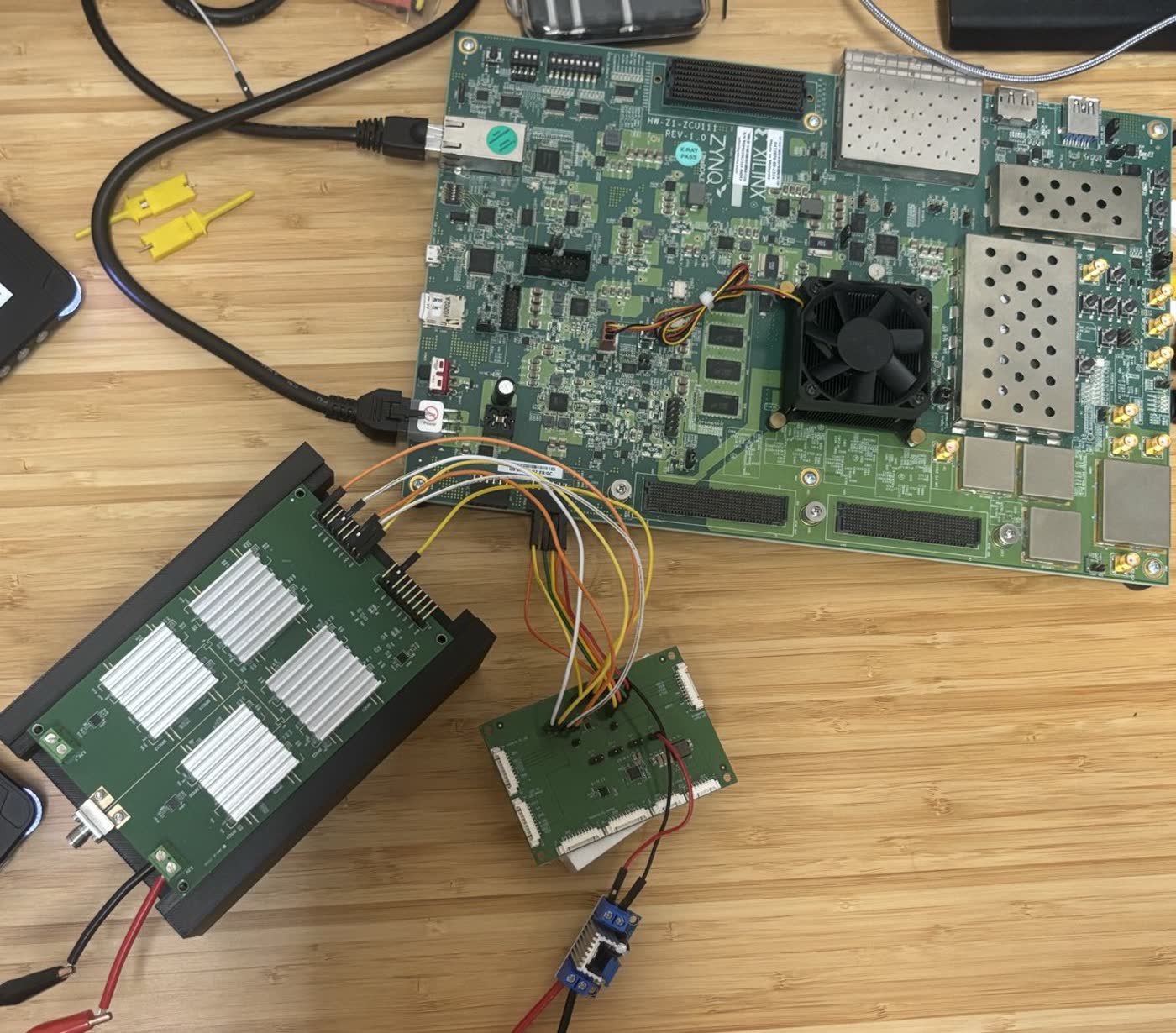
The first-generation S-band version has already detected drones in live ground tests. Everything below is a browser simulation of this exact signal chain; the photo is the real thing.
New to radar? In plain terms: the glowing wedge is where the antenna is "looking." Steer it across a target and watch the echo pop out of the noise (the range–Doppler map) and get tracked on the scope.
Try it: click an object in the chart below to drop it into the radar above — pick the F-16 (clearly detected), then the F-117 stealth jet: a huge plane that nearly vanishes. The radar shows whether it was detected; raise SNR or add TX/RX elements to dig the faint ones out.
RCS is set by shape & materials, not size. The shaded objects are stealth aircraft — huge, yet they return a smaller echo than a bird; an F-16 returns ~1000× more. Click any object to drop it into the radar above and see if it can be detected.
Two hypotheses walked in. One walked out.
This field log is private.
Enter the passphrase to unlock the 65-conversation log.
Wrong passphrase. Try again.
How the market corrected me
Nine lines that changed a decision
Of the 25 lines I wrote down, these nine each bought a decision.
All 65 conversations
Filter by thread. This index was built by my own meeting-agent pipeline: recordings in, transcripts and structured summaries out, fully automated.
A bit about me

- I design and validate information-fusion algorithms for MIMO radar.
- I came up through NTHU EECS on terahertz imaging and signal processing — comfortable from the RF bench to the FPGA to the host-side algorithm.
- My advisor founded a Taiwanese startup doing antenna design, RF front-ends and satellite communications — I build its baseband and back-end, so I'm looking at this supply chain from inside it.
- cross-border work bridging technology and business in Epoch Foundation's MIT group;
- co-founded a non-profit repair community.
- Based inBased in Hsinchu and Taipei, Taiwan; in the Bay Area Jul–Aug 2026
- EducationM.S. Communication Eng., NTU (2025–27) · B.S. EECS, NTHU (2021–25)
- Focus nowMIMO radar baseband on a ZCU111 RFSoC — DBF, pulse compression, CFAR, tracking
- LanguagesMandarin (native) · English (professional)
- CertificationsAzure AI Fundamentals (Microsoft) · Transformer-Based NLP (NVIDIA DLI) · Altium PCB Design
Built & been part of
Honors & highlights
If you're one of these, let's grab a coffee
- Jul 6 – Aug 21, coffee's on me — not in the Bay? A video call works just as well.
- I'm carrying two things: a radar I can demo, and a licensing idea I want you to attack.
- Design partners get the live demo; skeptics get my honest numbers.
Rather reach out now? Email me, connect on LinkedIn, or book a coffee slot — any of the three below works.
Not on this list but think our worlds overlap? Reach out anyway — coffee's still on me.